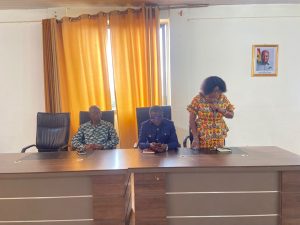
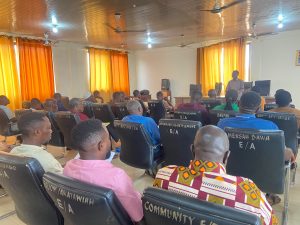
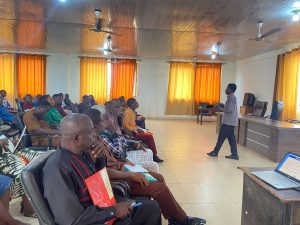
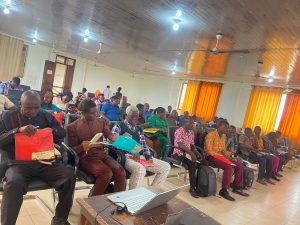
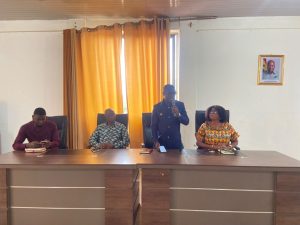
A training programmed on Next Generation Local Governance Leadership was organized for
Assembly Members of the Upper Manya Krobo District Assembly. The training formed part of the
Certificate Course on Next Generation Local Governance Leadership being implemented by the
Institute of Local Government Studies (ILGS). The training was held at the Assembly Hall of the
Upper Manya Krobo District Assembly. The programmed is scheduled to run from 13 July to 21
August 2026 and is aimed at strengthening the leadership capacity of Assembly Members and
preparing them to contribute effectively to local governance and development. The training
commenced with an opening session at the Assembly Hall of the Upper Manya Krobo District
Assembly. The District Coordinating Director, Madam Eunice N. Naalier, delivered the welcome
address. She welcomed the Assembly Members and other participants and emphasized the
importance of the training in building the capacity of Assembly Members to effectively perform
their roles within the decentralized local governance system. The District Chief Executive, Hon.
Emmanuel Kwesi laweh subsequently delivered the keynote address. He encouraged the Assembly
Members to take advantage of the training to strengthen their leadership capacity and improve
their contribution to the development of their respective electoral areas and the District as a
whole. Following the welcome and keynote addresses, the facilitator commenced the training with
an overview of the programmed, its objectives, expected outputs and the qualities expected of a
Next Generation Leader.The facilitator explained that the Next Generation Local Governance
Leadership Programmed seeks to develop Assembly Members into effective leaders capable of
contributing meaningfully to local governance and development.
The training emphasized that Assembly Members are leaders and not managers of the Assembly.
Participants were encouraged to develop a clear vision for their electoral areas, work closely with
their constituents and stakeholders, and take responsible decisions that promote community
development. A key distinction made during the training was that leadership involves doing the
right things, while management focuses on doing things right. Assembly Members were therefore
encouraged to demonstrate leadership by taking courageous decisions, managing resistance to
change and working with communities to achieve development objectives.
The specific objectives of the training were to:
* Improve participants’ knowledge of decentralization and the local governance framework.
* Build competencies in the performance of their deliberative, legislative, representative,
executive and oversight responsibilities.
* Enhance their skills in community mobilization, engagement and communication.
* Expose participants to career opportunities in local governance and prepare them for future
roles in national political leadership and development.
* Provide a platform for participants to build networks and share experiences for their
personal and professional development.
The facilitator outlined the major goals of the programmed, enabling Assembly Members to become
different and better in the five key areas of their functions, promoting local governance for
development, and using their performance at the local level to advance their careers in local or
national leadership. The training therefore encouraged participants to view their current positions
as opportunities to develop leadership skills and experience that can contribute to effective
governance at both the local and national levels. The training defined a Next Generation Leader as
a person who can envision the future possibilities of an electoral area and community and work
with the people to pursue that vision.
The facilitator identified several characteristics of an effective Next Generation Leader, including:
* Having a clear vision for the electoral area and community.
* Demonstrating leadership rather than simply managing Assembly activities.
* Taking courageous and responsible decisions.
* Managing forces that may resist positive change.
* *Working with citizens and stakeholders to achieve shared development objectives.
Assembly Members were encouraged to see themselves as agents of positive change within their
communities. Next Generation Leaders, The programmed seeks to develop Assembly Members
through several approaches. These include stimulating changes in their mindset, equipping them
with essential leadership skills for their deliberative, legislative, representative, executive and
oversight roles, and exposing them to contemporary successful national leaders who have followed
similar leadership paths. The programmed also seeks to identify, network and empower emerging
leaders to become role models for other Assembly Members. The facilitator presented the expected
outputs of the programmed. The training programmed is expected to cover 9,622 participants,
comprising 6,272 elected Assembly Members, 2,813 government appointees of MMDAs, 261
Metropolitan, Municipal and District Chief Executives, and 276 Members of Parliament. The
programmed is also expected to include 261 training events or centers and 22 mobile training teams
operating across the 16 regions of Ghana.
Other expected outputs include:
* 261 MMDA-based training reports.
* 22 mobile training team reports.
* One consolidated national report.
* A Handbook for Next Generation Local Governance Leadership and relevant local
governance laws.
* Programmed briefs and presentation materials.
* Leadership change-making projects to be undertaken by Assembly Members.
The training provided Assembly Members with an opportunity to reflect on their leadership
responsibilities and their role in the decentralization process. One of the key lessons was the
importance of having a clear vision for the development of an electoral area and working with
constituents to achieve that vision. The facilitator also stressed the need for effective
communication, community engagement and mobilization. Participants were encouraged to take
courageous decisions, embrace positive change and develop networks that can support their
leadership and professional development. At the end of the training programmed, Assembly
Members are expected to have improved knowledge of decentralization and local governance and
enhanced competencies to perform their functions effectively. The programmed is also expected to
improve participants’ capacity in community engagement, communication, leadership and
decision-making, while preparing them for future leadership responsibilities at the local and
national levels. The Next Generation Local Governance Leadership Training for Assembly
Members was successfully held at the Assembly Hall of the Upper Manya Krobo District
Assembly. The opening session featured a welcome address by the District Coordinating Director,
Madam Eunice N. Nailer, followed by a keynote address from the District Chief Executive, Hon.
Emmanuel Kwesi laweh the facilitator then proceeded with the training, covering the objectives,
goals, expected outputs and leadership principles of the Next Generation Local Governance
Leadership Programmed. The training provided Assembly Members with valuable knowledge and
perspectives on effective local leadership, community engagement, responsible decision-making
and the role of Assembly Members in advancing local development. The programmed is expected
to strengthen the capacity of Assembly Members to effectively represent their constituents,
contribute to local development and provide responsive leadership within the decentralized
governance system